

You found the house. Pool looks great. There’s a dock behind it. Maybe even a boat lift. The listing says “Gulf access.”
There’s just one problem: can your actual boat get from that dock to open water?
That’s a question I’d rather answer before we tour the house than after you’ve fallen in love with it.
1. Boat length isn’t enough
You tell me, “Chris, I have a 24-foot boat.” Great start. But two 24-foot boats can have completely different heights, beams, drafts, weights and lift requirements.
For Cape Coral waterfront searches, air draft — how high the boat extends above the waterline — can become especially important because of bridges. Draft matters below the water. Beam and realistic operating weight matter when we get to the dock and lift.
2. Your T-top, Bimini or hardtop might be the important part
A recreational boat does not have to be huge to have a bridge issue. Add a T-top, hardtop, tower, radar or antennas to a center console and the number we care about changes quickly. Same with a pontoon and its Bimini.
Don’t know the air draft? Give me the year, make and model and we can start with published specifications. If the clearance is close, though, we verify rather than trust an internet spec to the inch.
3. The lowest bridge on the route wins
You do not need to memorize every bridge in Cape Coral. You need to know the bridges between this house and the water you want to reach.
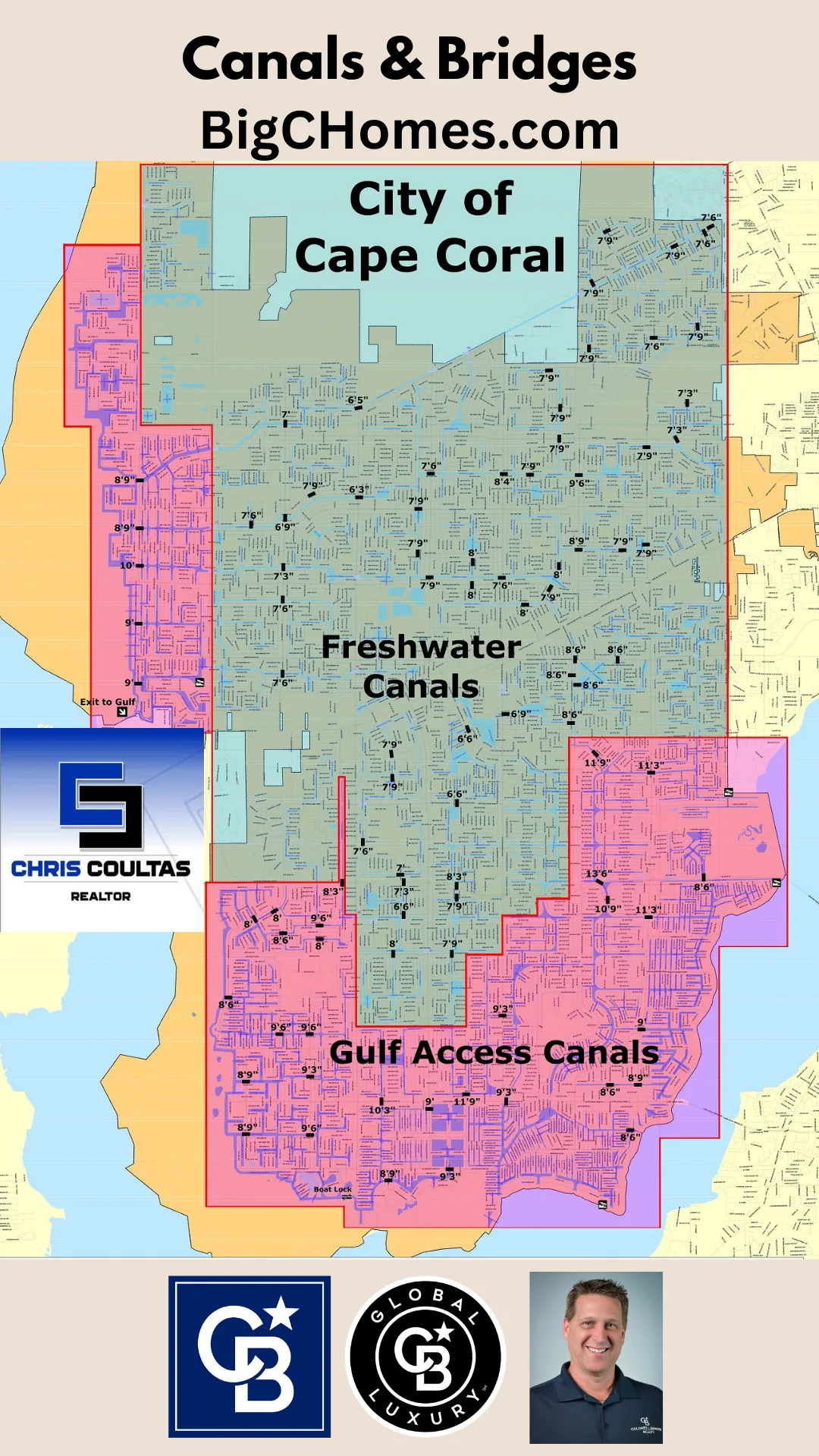
If four bridges have plenty of room and one is lower, that lower bridge controls the route. Cape Coral’s public bridge data is useful for screening, but the City warns that GIS mapping varies in accuracy and is not intended for precise measurement. When the boat is close to the number, verify.
4. What this looks like with normal Cape Coral boats
22-foot pontoon
I want overall height, Bimini configuration, beam, lift setup and the actual bridge route. If the pontoon comfortably clears the route, there may be no reason to eliminate every bridge-restricted property — or pay a premium for access the boat does not need.
24-foot center console with a T-top
The length may be the least interesting number. T-top height and anything mounted above it can decide which routes make sense.
23-foot bay or fishing boat
Shallow draft helps, but it does not erase bridges. Route, height, dock setup and where you actually want to fish still matter.
Sailboat with a fixed mast
Now bridge restrictions can dominate the search. The complete route has to work with the mast height.
5. Bridge clearance isn’t the only number: water depth matters too
Cape Coral says sedimentation and erosion can reduce canal depth and affect navigability. Under the City’s current maintenance dredging permits, dredging is limited to a maximum of 5 feet below mean low water (MLW).
That does not mean every canal is five feet deep. It is the maximum permitted dredging depth. Actual conditions vary, so a buyer whose boat has meaningful draft should verify the specific property and route.
6. Okay, the route works. Does the dock?
Now we check whether the existing lift has enough capacity and the right cradle/piling setup, whether the beam physically fits, whether the dock configuration works and whether the seawall deserves closer evaluation. “Boat lift included” is not the same as “this lift works for my boat.”
Read my seawalls, docks & boat lifts guide →
7. Why I start with the property address
Bridge lists and boating maps are useful, but they are backwards for the question I’m trying to answer. You are not buying a bridge. You are buying a house.
So start with the house. Enter the address in the Cape Coral Water Map, trace the route and see which bridges are actually relevant.
Will MY boat work at THIS house?
That’s the question. Check the address on the map, then send me the property plus your boat year/make/model if you want a second set of eyes on it.
My waterfront search shortcut
Before I start sending Gulf-access homes to a serious boater, I like to collect the boat year/make/model, length, beam, height, draft, realistic lift weight, where they want to boat and how much canal travel feels reasonable. You don’t have to know every answer. Send me what you have.
Waterfront buyer FAQ
Will a pontoon fit under Cape Coral bridges?
Many can, but “pontoon” is not enough information. Check the boat’s actual height and the bridges on the specific property route.
Does Gulf access mean no bridges?
No. A Gulf-access property can have one or more fixed bridges on the route.
Is no-bridge access always better?
It offers more flexibility for taller boats, but if your boat comfortably works on a bridge-restricted route, the best value may be somewhere else.
Are Cape Coral canals five feet deep?
No. Five feet below mean low water is the City’s maximum permitted maintenance dredging depth, not a guaranteed depth for every canal.
What if I don’t know my boat’s height or draft?
Send the year, make and model. We can start with the specifications and identify what needs to be confirmed.
Can you check a house before I schedule a showing?
Yes. Send me the Cape Coral address and whatever you know about the boat. That is exactly the point of screening the route first.